Article
Adobe Commerce as a Cloud Service and Edge Delivery Services
Adobe Commerce as a Cloud Service (SaaS) and Edge Delivery Services change how a store is built: an Adobe-managed backend and a lightning-fast storefront from the edge. What they are, when they fit and how to migrate.

On this page
- Adobe's digital commerce is going SaaS
- What is Adobe Commerce as a Cloud Service (the SaaS model)?
- SaaS, PaaS and on-premise: three ways to run Adobe Commerce
- What is Edge Delivery Services for Commerce?
- Drop-in components, boilerplate and document-based authoring
- Why SaaS + Edge Delivery matter in 2026
- 1. Performance: speed = conversion + SEO
- 2. TCO and operating cost
- 3. Time-to-market
- When does Adobe Commerce SaaS + Edge Delivery fit? (and when it does not)
- How to migrate toward the SaaS stack without rebuilding everything
- Frequently asked questions
- Related services
Adobe's digital commerce is going SaaS
For over a decade, running a store on Adobe Commerce (formerly Magento) meant managing servers, planning version upgrades and maintaining a PHP monolith. That model is still valid and powerful — but it is no longer the only one. Adobe is moving its platform toward a SaaS (software as a service) model with two new pieces worth understanding before your next project: Adobe Commerce as a Cloud Service and Edge Delivery Services.
At WolfSellers we have spent more than 10 years implementing the Adobe ecosystem exclusively across Mexico and LATAM, and we see this shift as the most significant since the Magento acquisition. Here is the no-marketing explanation: what each one is, how it differs from the classic model, and when it fits — and when it does not.
What is Adobe Commerce as a Cloud Service (the SaaS model)?
Adobe Commerce as a Cloud Service (ACCS) is the SaaS edition of Adobe Commerce: Adobe runs, scales and updates the platform for you. You do not manage infrastructure, you do not plan version migrations and the store is always current. It is composable and API-first: catalog, pricing and cart are exposed as services consumed via API (GraphQL and REST), rather than living inside a monolith you host.
The key difference versus the previous model is who carries the operational burden:
- In the classic model, your team (or your partner) owns hosting, security patches, major upgrades and performance.
- In SaaS, that responsibility shifts to Adobe. Your team focuses on the business: catalog, experience, content and conversion.
SaaS, PaaS and on-premise: three ways to run Adobe Commerce
Adobe Commerce can be run in three ways today. There is no universal "best" — there is a right one for your case.
| Model | Who manages infrastructure | Upgrades | Best fit |
|---|---|---|---|
| On-premise (self-hosted) | You / your team | Manual, major | Data sovereignty needs, full control, highly custom cases |
| Cloud (PaaS) — Adobe Commerce on Cloud | Adobe manages infra; you manage the app and version | You plan the upgrade | Complex catalogs, heavy custom logic, advanced B2B |
| SaaS — Adobe Commerce as a Cloud Service | Adobe manages everything | Automatic, continuous | Fast time-to-market, lean teams, lower operating cost |
Note: the existence of the SaaS model does not "kill" PaaS or on-premise. For very large catalogs, deep integrations or very specific B2B logic, the PaaS model remains the right choice. SaaS shines when the priority is speed to launch and low operating cost.
What is Edge Delivery Services for Commerce?
Edge Delivery Services (EDS) is Adobe's modern storefront layer: it serves the store from the edge (the distribution network closest to the user) to achieve near-instant pages. It was born in the Adobe Experience Manager world and today also powers Adobe Commerce stores.
In practice, Edge Delivery decouples the frontend from the backend: the storefront is lightweight, extremely fast and consumes commerce data via API. This solves Magento's old monolithic-frontend pain (heavy, hard to optimize for Core Web Vitals).
Drop-in components, boilerplate and document-based authoring
Three concepts define how a storefront is built with Edge Delivery:
- Drop-in components — reusable, production-ready commerce components (PLP, PDP, cart, mini-cart, checkout, search). You "drop them in" and customize, instead of building from scratch.
- Storefront boilerplate — a base template that starts the project with performance and SEO best practices already baked in.
- Document-based authoring — content authors can edit pages from documents (Google Docs / Word / SharePoint style) without touching code, alongside traditional code-based authoring for technical teams.
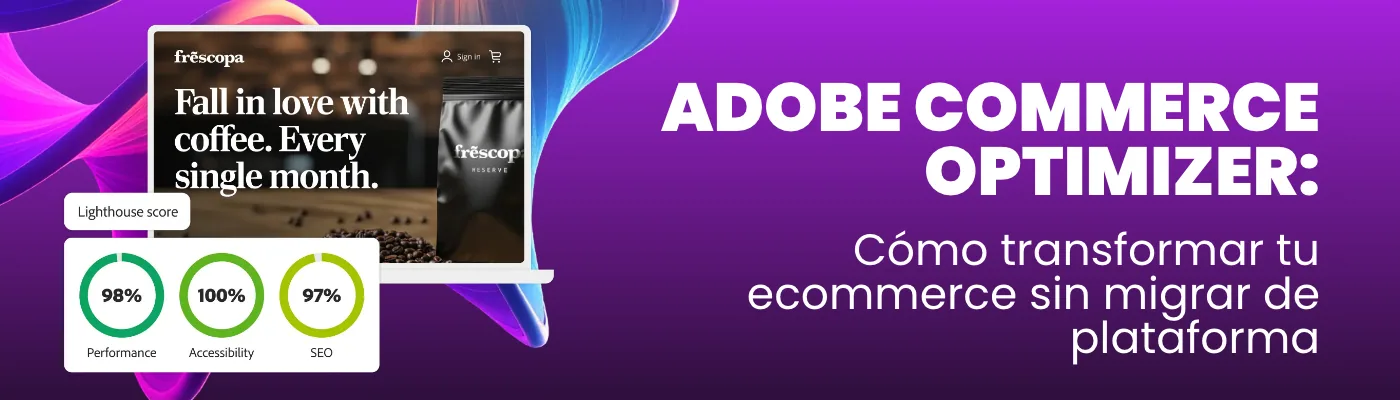
The typical result: storefronts that reach Lighthouse scores near 100 and sub-second load times — something that was very hard to sustain with the classic Luma frontend.
Why SaaS + Edge Delivery matter in 2026
Together, ACCS (SaaS backend) and Edge Delivery (edge storefront) form Adobe's most modern composable commerce stack. Three reasons this matters for a brand in Mexico:
1. Performance: speed = conversion + SEO
Store speed is not a technical luxury: it directly impacts revenue and ranking. Google uses Core Web Vitals as a ranking signal, and industry studies (Google, Deloitte) have consistently shown that fraction-of-a-second improvements in load time lift conversion rate. An edge storefront starts ahead on both fronts.
2. TCO and operating cost
SaaS removes costs that were constant in the classic model: infrastructure management, maintenance windows, recurring major upgrade projects. For a lean team, that means lower recurring spend and lower risk. (Adobe license pricing is handled under direct agreement; here we are talking about operating cost, not licensing.)
3. Time-to-market
With drop-in components and an optimized boilerplate, the time to launch or iterate drops noticeably versus building a Luma theme or a custom headless frontend from scratch. You launch sooner, test sooner and learn sooner.
When does Adobe Commerce SaaS + Edge Delivery fit? (and when it does not)
We are an honest partner: this stack is not for everyone. It fits when:
- You want to launch or relaunch fast and do not want to carry infrastructure.
- Storefront performance is a priority (SEO, Core Web Vitals, conversion).
- Your team is lean and prefers to focus on the business, not on running servers.
- Your catalog and integrations are standard to moderately complex.
It is worth pausing to evaluate PaaS or on-premise when:
- You have highly custom business logic that depends on deep core customizations.
- Your B2B operation requires very specific rules, catalogs and approval flows.
- You have strict data sovereignty requirements or legacy integrations that need full control of the environment.
There is no single answer. That is why the first thing we do at WolfSellers is not propose a platform, but understand your operation, your customer and your roadmap.
How to migrate toward the SaaS stack without rebuilding everything
The migration does not have to be a big bang. A realistic path:
- Assessment — which parts of your operation fit SaaS and which require PaaS (a hybrid approach when it applies).
- Storefront first — adopting Edge Delivery for the frontend usually delivers the fastest ROI (performance + SEO) even before moving the backend.
- Backend in phases — move commerce services to ACCS incrementally, prioritizing what weighs most on operating cost.
- Data and content — leverage document-based authoring so marketing can iterate without depending on every deploy.
Frequently asked questions
Does Adobe Commerce as a Cloud Service replace Adobe Commerce on Cloud (PaaS)? No. They coexist. SaaS (ACCS) is for those who prioritize speed and low operating cost; PaaS remains the right choice for very large catalogs, custom logic and deep integrations. The right decision depends on your case.
Does Edge Delivery Services require the SaaS model? Not necessarily. Edge Delivery is the storefront layer and can add value (performance, SEO) even on top of a PaaS backend. Many brands start there.
What happens to my current Magento / Adobe Commerce store? It remains valid. The migration toward SaaS + Edge Delivery can be done in phases, starting with the storefront. There is no need to throw everything away and start over.
Who implements Adobe Commerce SaaS and Edge Delivery in Mexico? WolfSellers is an Adobe Gold Partner in Mexico with more than 10 years implementing the Adobe ecosystem (Commerce, Experience Manager, Experience Platform) for brands in Mexico and LATAM. We support the assessment, the phased migration and ongoing operation.
Does Edge Delivery improve SEO? Indirectly, yes: by serving the storefront from the edge with high Core Web Vitals, it improves the page-experience signals Google uses to rank, plus load times that favor conversion.
Related services
If this topic is relevant to your business, these services from WolfSellers can help you implement it: