
Article
Retail Media Networks (RMN): Monetize Your eCommerce with Adobe Commerce
Discover how to transform your eCommerce with Adobe Commerce into an RMN and generate millions. Leverage your First-Party data for a new advertising revenue stream.

On this page
- What is a Retail Media Network (RMN)?
- The Power of Adobe Commerce: From Retailer to Publisher
- A Composable, Scalable Platform for Large-Scale Monetization
- High-Value On-Site Advertising and Precise Targeting
- User Experience and Conversion as Top Priorities
- A Roadmap for Success: Key Steps to Implement Your RMN
- The Future of Retail is a Media Platform
- Related services
Retail Media is not the future: it's already here. And if you have an eCommerce platform, you're sitting on an untapped goldmine… and this article is for you.
First, imagine that your eCommerce platform isn't just a store — it's a packed stadium on the day of the championship final.
You have thousands of people with their credit cards in hand, ready to buy. For years, you've only made money from ticket sales (your products). But what about all that prime real estate surrounding the field?
That space, at that exact moment, becomes the focal point where every eye is looking. And up until now, you weren't taking advantage of it.
Today, that changes. Your most valuable asset isn't just your digital shelves — it's the data on who's in that stadium and what they want to buy. By monetizing that knowledge and that space, you're opening up a new business unit: the Retail Media Network (RMN).
In essence, you become a media powerhouse that offers partner brands the opportunity to speak directly to their customers right before they make a purchase decision.
The key lies in the infrastructure. And in this high-stakes game, Adobe Commerce is the platform that gives you complete control.

What is a Retail Media Network (RMN)?
A Retail Media Network is an advertising infrastructure that a retail company offers to third-party brands, enabling them to run advertising campaigns within its digital channels (websites, apps, and even physical point-of-sale locations).
The great value of an RMN lies in the fact that advertising is enriched with the retailer's first-party data (purchase history, browsing behavior, loyalty segments), enabling more precise targeting and more direct ROI measurement than traditional platforms.
The market shift away from third-party cookies is driving retailers to use their own data for advertising, capturing a larger share of advertising spend in the process.
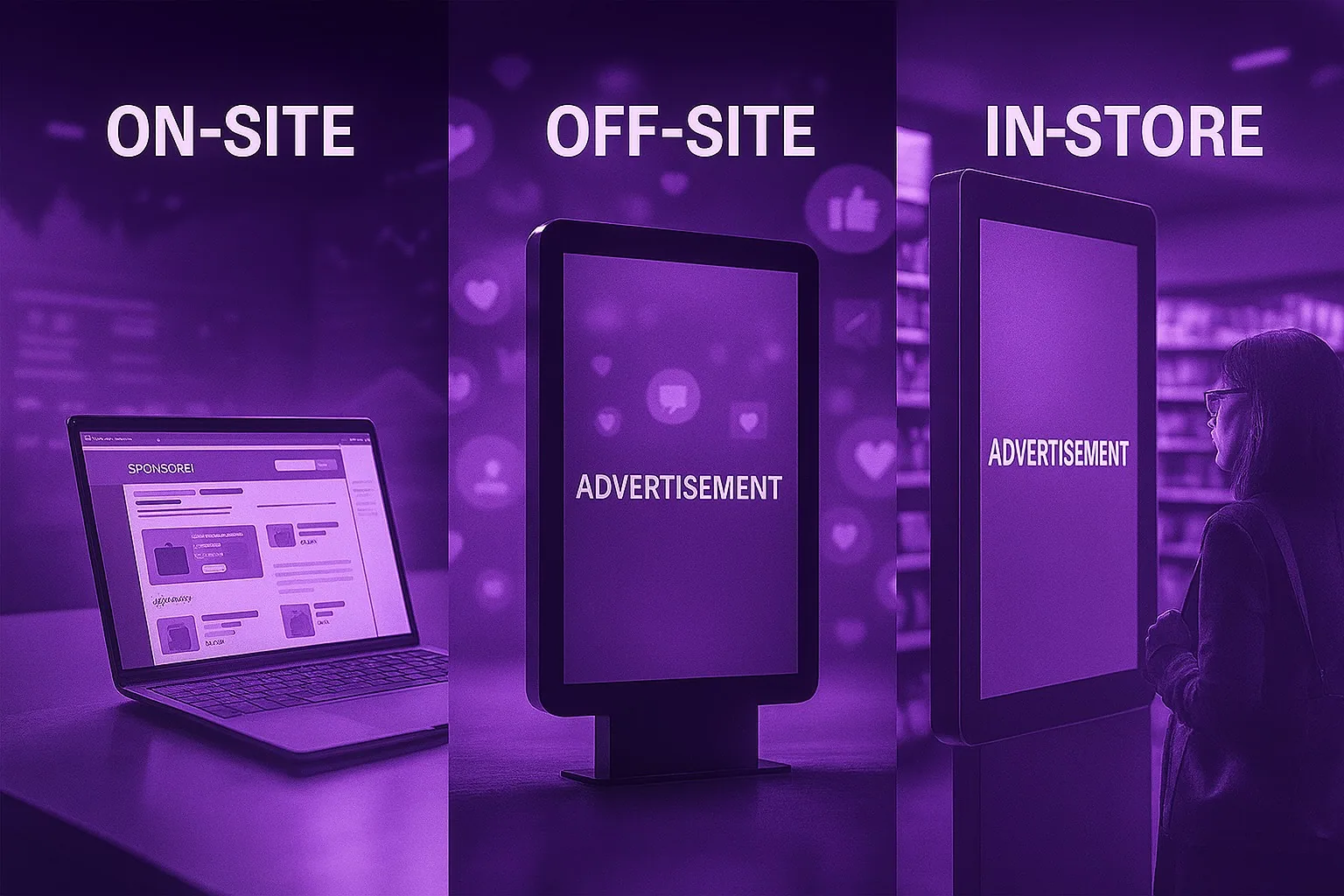
There are three main types of ads in an RMN:
On-site: Ads that appear on the retailer's platform (e.g., banners, sponsored listings in search results). Off-site: Ads that use the retailer's data to target audiences outside their site (e.g., on social media or through programmatic advertising). In-store: Ads on digital screens or interactive signage inside the physical store.
The Power of Adobe Commerce: From Retailer to Publisher
The key to launching and scaling a profitable RMN is having a robust, flexible, and data-driven eCommerce platform.
This is where Adobe Commerce (part of Adobe Experience Cloud) becomes the ideal engine, providing the essential tools to transform digital assets into a source of advertising revenue.
A Composable, Scalable Platform for Large-Scale Monetization
Adobe Commerce is designed to meet the needs of businesses handling large transaction volumes and exponential growth. Its cloud-native capabilities and API-based architecture (formerly Magento) offer:
Unlimited Scalability: As a cloud-native solution, Adobe Commerce can handle traffic spikes and massive order volumes (essential during the sale of advertising inventory at key events) without sacrificing performance (Source: Adobe Commerce on Cloud - Product Description). Flexibility and Extensibility: Its composable, API-first nature makes it easy to integrate with third-party advertising management tools (Ad Tech). This is vital for advertising inventory sales and automated management.
Unified B2B and B2C Support: The platform can manage both B2C retail commerce and complex B2B transactions. This capability expands the potential advertiser base (consumer brands and industrial suppliers alike), multiplying monetization opportunities.
High-Value On-Site Advertising and Precise Targeting
Adobe Commerce allows you to turn high-value pages into premium placements for advertisers by leveraging the Adobe Experience Cloud ecosystem:
Strategic Placements and Measurement (Adobe Analytics): The platform makes it easy to create ad spaces at high-visibility points: homepages, category pages, and right on product pages. By integrating with Adobe Analytics, both the retailer and the advertiser gain detailed insights into user behavior and ad effectiveness.
Data Integration (Real-Time CDP): By connecting with Adobe Experience Platform and its Real-Time Customer Data Platform (Real-Time CDP), the retailer can unify browsing and transaction data to create secure, unified customer profiles. This allows advertisers to launch ultra-targeted campaigns, increasing ad relevance and, therefore, the value of the advertising inventory. (Source: Adobe Real-Time CDP).
AI-Powered Personalization and Content Generation: Tools like LLM Optimizer (part of Adobe Experience Platform) can assist with the automatic creation of personalized ad content and copy optimization for different segments, scaling creativity and campaign impact without the need for massive manual effort.
User Experience and Conversion as Top Priorities
A successful RMN must enrich — not interrupt — the shopping experience. Adobe Commerce ensures that advertising integrates naturally:
Unified Experiences: Adobe Commerce makes it easy to create shopping experiences that blend advertising with product content, guiding customers in a relevant way and improving conversion (Gross Merchandise Volume - GMV), which benefits both the retailer and the advertiser.
Performance Optimization (Commerce Optimizer): Tools like Commerce Optimizer ensure a high-performance storefront, A/B testing, and AI-powered merchandising. This guarantees that the inclusion of ads doesn't compromise page speed — a key factor in customer retention. (Source: Adobe Commerce Optimizer).

A Roadmap for Success: Key Steps to Implement Your RMN
Launching a Retail Media Network is a strategic transformation. Here are the essential steps to begin this journey with Adobe Commerce as your foundation:
Creating a Retail Media Business Unit: This should be a separate team dedicated exclusively to selling advertising inventory, generating transparent reports, and optimizing campaigns.
Investing in Technology and Resources: Acquiring and configuring the right technology stack. This includes the base commerce platform (Adobe Commerce), the customer data management solution (CDP), and Ad Tech tools that integrate via API.
Defining a Pricing Strategy (Cost per Click / Impression): Establishing the value of advertising placements based on data quality, traffic volume, and the purchase-closing capability your platform offers.
Prioritizing User Experience (UX): Ensuring that ads are perceived as valuable content that helps customers find the ideal product, rather than an interruption.
The Future of Retail is a Media Platform
Retail Media Networks built on Adobe Commerce represent the natural evolution of eCommerce. By monetizing their digital assets and first-party data, retailers secure a new, profitable revenue stream while offering their partner brands deterministic, measurable, and highly targeted advertising at the exact point of purchase.
Adobe Commerce provides the scalable and flexible technology foundation that retailers need not just to participate in, but to lead, this advertising revolution. It's time to stop being just a seller and start acting like a publisher — with the right platform to back it up.

Related services
If this topic is relevant to your business, these services from WolfSellers can help you implement it: