Article
Agentic Commerce: What It Is and How to Prepare Your Adobe Commerce
Agentic commerce changes who buys: AI agents that compare, decide and execute. What it is and how to prepare your Adobe Commerce store for this era.

On this page
- Commerce Is No Longer Done by Humans Alone
- What Is Agentic Commerce?
- The Engine Behind the Agent: AI Models
- Why 2026 Is the Tipping Point
- What Changes for Your Adobe Commerce Store
- How to Prepare Your Adobe Commerce for Agentic Commerce
- 1. Structured, Clean Product Data
- 2. An API-Connected Architecture (Headless / Composable)
- 3. Search and Catalog a Machine Can Read
- 4. Unified Customer Data for Personalization
- 5. Governance: Control, Security and Business Rules
- The Risks of Getting It Wrong (and How to Avoid Them)
- How We See It at WolfSellers
- Related Services
- Related services
Commerce Is No Longer Done by Humans Alone
For 25 years, e-commerce optimized for one thing: getting a person to browse, compare and buy on a screen. The entire discipline — UX, product pages, checkout, retargeting — was designed around that human click.
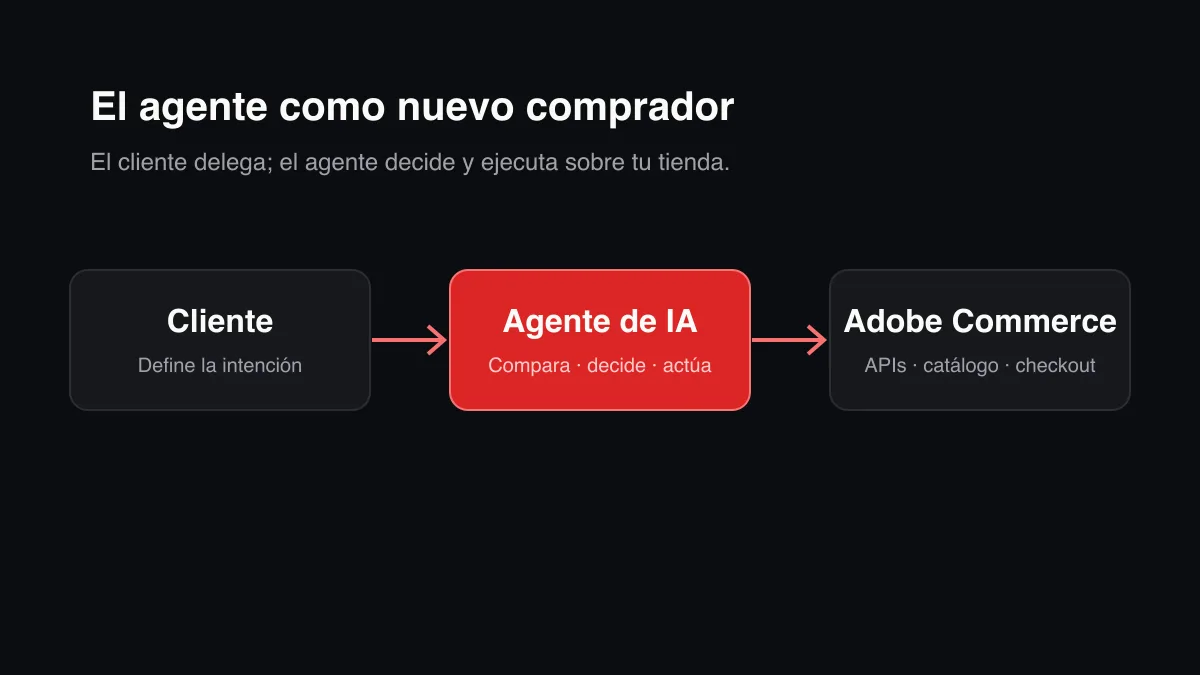
That assumption is changing. Increasingly, between your customer and your store sits an artificial intelligence agent that researches, compares options and, in many cases, executes the purchase on their behalf. The buyer does not disappear: they delegate.
This is called agentic commerce, and it is not science fiction five years out. It is the direct consequence of the AI assistants your customers already use every day. At WolfSellers we look at it from what matters: what it means for a store built on Adobe Commerce (formerly Magento), and what you need to do today so you are not left out of the answer.
What Is Agentic Commerce?
Agentic commerce is a buying model in which an AI agent acts on behalf of the user across the entire journey: it understands an intent ("I need to restock this supply at the best price with delivery this week"), searches across multiple sources, evaluates alternatives against the customer's criteria and executes actions — add to cart, apply a coupon, complete checkout — without the person touching every step.
The difference with traditional e-commerce is fundamental, not cosmetic:
| Traditional commerce | Agentic commerce |
|---|---|
| The human browses and clicks | The agent researches and executes on request |
| You optimize for eyes (design, visual UX) | You optimize for machines (structured data, APIs) |
| Traffic lands on your home/PLP/PDP | The agent queries your catalog via API or feed |
| You win the sale with visual persuasion | You win the sale with clean data and clear availability |
| One session = one customer | One agent query can compare 20 stores in seconds |
The strategic consequence is uncomfortable but clear: if your store cannot be read and understood by a machine, the agent skips it and recommends your customer to a competitor that is prepared.
The Engine Behind the Agent: AI Models
What makes the agent possible is not magic: it is reasoning language models capable of planning several steps, using tools (APIs, search engines, carts) and holding the context of a complex task until it is complete.
Frontier models like Claude (Fable 5) from Anthropic, alongside those of other providers, are exactly the kind of engine that lets an agent move from "answering a question" to "executing a purchase end to end." It is not the core topic for your business — the specific model will change every few months — but it does explain why this is happening now and not before: the ability to reason and act in chained steps is now good enough to operate over a real catalog.
The question for a brand is not which model the agent uses. It is: when that agent reaches my store, will it be able to understand it and buy, or will it leave?
Why 2026 Is the Tipping Point
The strongest signal is not the hype — it is the gap between intent and capability. According to data presented by Adobe together with Oxford Economics:
| Indicator | Figure |
|---|---|
| Organizations expecting agentic AI to manage most of their interactions within the next 18 months | 78% |
| Organizations that have it implemented today | Only 16% |
| Organizations with adequate cloud infrastructure to operate it | Only 51% |
| Organizations naming data quality as their main limitation | 75% |
The takeaway is direct: almost everyone wants to operate with agents, but most lack the data and the architecture to do it. That gap is exactly where the next few years will be decided. And in retail the effect is already felt: Adobe Analytics has reported that traffic reaching commerce sites from generative AI sources is growing at an accelerating pace — visitors who no longer typed your brand into Google, but arrived because an assistant sent them.
What Changes for Your Adobe Commerce Store
If the agent is a new kind of "customer," then your store has a new kind of visitor with different needs:
- It does not see your design. It does not care about your hero, your palette or your cart animation. It reads data.
- It demands structure. It needs clear product attributes, consistent prices, real availability and explicit policies (shipping, returns, warranty).
- It queries by API, not by session. It expects fast, typed, reliable responses — not fragile scraping of your HTML.
- It compares without loyalty. It evaluates your offer against others in seconds. The cleanest data and the clearest availability win, not the prettiest banner.
The good news: Adobe Commerce is among the best-positioned platforms for this, because its architecture is already API-first (REST, GraphQL) and composable. You are not starting from zero — but there is concrete work to do.
How to Prepare Your Adobe Commerce for Agentic Commerce
Here is what we recommend prioritizing, in order of impact:
1. Structured, Clean Product Data
This is the foundation. Complete and consistent attributes, a coherent taxonomy, prices and promotions without ambiguity, and real-time availability. An agent discards what it does not understand: a product page with empty or contradictory fields is invisible to it. Here, a mature product data management (PIM) practice and a well-governed catalog stop being "nice to have."
2. An API-Connected Architecture (Headless / Composable)
The agent consumes data, not pages. Exposing catalog, inventory, prices and checkout through robust APIs — the territory of composable commerce and headless — is what lets an external system operate your store reliably. If your modern architecture is still pending, it is worth reviewing the path toward Adobe Commerce SaaS and Edge Delivery.
3. Search and Catalog a Machine Can Read
Powerful, semantic search (like Live Search) does not just improve the human experience: it gives the agent precise, ranked answers it can consume directly. A readable catalog = a higher chance of being the recommended option.
4. Unified Customer Data for Personalization
When the agent acts for a known customer, 1:1 personalization still matters — even more so. A unified customer view on Adobe Experience Platform and audience activation with Adobe Real-Time CDP let the right offer reach the right agent at the right moment.
5. Governance: Control, Security and Business Rules
Opening your store to agents does not mean losing control. Clear business rules (segment pricing, purchase limits, fraud validations), API authentication and traceability of which agent did what. Openness without governance is a risk; governed openness is an advantage.
The Risks of Getting It Wrong (and How to Avoid Them)
Let's be honest — this is not flipping a switch:
- Opening APIs without security exposes prices, inventory and business logic. Agentic readiness is, first and foremost, an exercise in secure architecture.
- Chasing the hype without clean data means spending on the visible part (a "chatbot") while the foundation — the catalog — stays broken. Order matters: data first, conversation second.
- Giving up control of brand and price. If the agent builds the comparison, your availability, your data and your rules are your only way to compete. Neglecting them means competing on price alone.
The failure pattern is always the same: treating agentic commerce as a feature, when it is a change in architecture and operations.
How We See It at WolfSellers
Our conviction is simple: the 2026 advantage is not having AI, it is being ready to operate it. And that is built from the foundations — data, architecture and governance — not from the latest trendy model.
That is why we accompany brands not only as Adobe Commerce implementers, but as a strategic partner: we help define what experience you want to orchestrate and what you are missing to achieve it, and then we build it with Adobe Experience Cloud technology and our AI & Automation practice. If you want to go deeper into how digital experience is becoming agentic end to end, we cover it in our note on Digital Experience 2026; and if your priority is being visible when AI builds the answer, see our LLMO and GEO guide.
Agentic commerce does not ask whether your site is pretty. It asks whether your store can be operated by a machine. That is the conversation worth having now. Let's talk.
Related Services
If this topic is relevant to your business, these WolfSellers services can help you implement it:
Related services
If this topic is relevant to your business, these services from WolfSellers can help you implement it: