Article
Digital Experience 2026: AI, Brand Visibility and the Content Supply Chain
Four digital experience trends for 2026: AI that interprets your brand, an agentic content supply chain, real-time personalization and open ecosystems.
On this page
- Customer Experience Is No Longer Designed: It Is Orchestrated in Real Time
- What Is the Agentic Enterprise?
- The 2026 Gap: Wanting to Use AI Is Not the Same as Being Able to Operate It
- The 4 Digital Experience Trends Redefining 2026
- 1. AI Interprets Your Brand Before the Customer Ever Arrives
- 2. The Content Supply Chain Becomes an Agentic System
- 3. Real-Time Personalization Stops Being Aspirational
- 4. The Open Ecosystem as the New Competitive Advantage
- The Real Challenge: Strategic Clarity Before Technology
- What Does This Mean for Your Company?
- Orchestration Is No Longer a Trend: It Is the Foundation of Digital Business
- Related Services
- Related services
Customer Experience Is No Longer Designed: It Is Orchestrated in Real Time
Not long ago, Adobe Summit took place — one of the most relevant global events around digital experience. Every year, the event sets the agenda for what is coming in marketing, content, data and commerce. But this edition left behind more than product announcements.
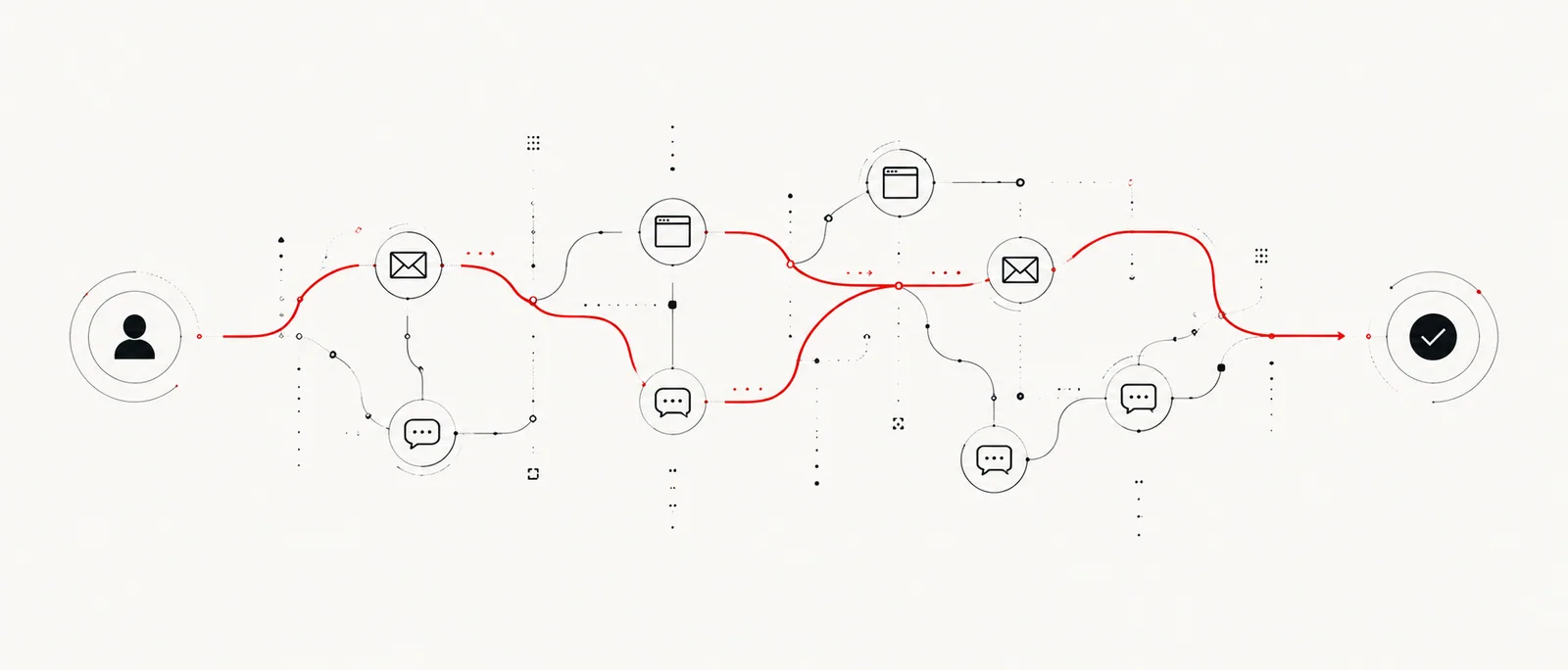
Beyond the launches, one thing became clear: customer experience is no longer designed… it is orchestrated in real time.
Today, artificial intelligence, brand visibility, customer interaction and the content supply chain no longer operate as separate initiatives. They are merging into systems that run autonomously, continuously and in a connected way. And that completely redefines what doing digital marketing means in 2026.
At WolfSellers we analyzed the trends that ran through the entire event — and what they mean for companies building their digital experience strategy this year.
What Is the Agentic Enterprise?
If there was one single idea connecting every keynote, every session and every conversation, it was this: managing customer experience is no longer enough. The competitive advantage is orchestrating it.
This is where the concept that defined this new stage comes in: the agentic enterprise. It is an operating model where artificial intelligence does not just generate content — it also:
- Makes decisions based on data and context.
- Automates entire processes, not just isolated tasks.
- Executes actions in real time, without waiting for a team to intervene.
The shift is profound: software stops being a passive tool and becomes an active system. It is no longer something a team operates; it is something a team directs.
But this vision also exposes an uncomfortable reality: many companies want to operate this way… and they are not ready.
The 2026 Gap: Wanting to Use AI Is Not the Same as Being Able to Operate It
According to data presented by Adobe together with Oxford Economics, the distance between expectation and real operational capability is enormous:
| Indicator | Figure |
|---|---|
| Organizations expecting agentic AI to manage most of their interactions within the next 18 months | 78% |
| Organizations that have it implemented today | Only 16% |
| Organizations with adequate cloud infrastructure to operate it | Only 51% |
| Organizations naming data quality as their main limitation | 75% |
The takeaway is direct: the most important trend of 2026 is not AI. It is the gap between wanting to use it… and being able to operate it. Whoever closes that gap first — with clean data, adequate infrastructure and connected processes — will compete in a different league.
The 4 Digital Experience Trends Redefining 2026
1. AI Interprets Your Brand Before the Customer Ever Arrives
One of the most relevant transformations is that AI has already become an intermediary. Today, users do not always reach your site directly: first they go through assistants, intelligent search engines or agents that filter information for them.
This completely changes the logic of visibility: your brand no longer just needs to rank. It needs to be understood by AI.
The problem is that many brands are not prepared for this. If your content is:
- Inconsistent — saying different things on every channel.
- Unstructured — lacking a clear hierarchy a system can interpret.
- Disconnected — fragmented across sites, product pages and repositories that do not talk to each other.
…AI simply fills in the gaps with whatever it finds — or leaves you out of the answer entirely.
Adobe responds to this challenge with solutions like Brand Intelligence, which allow AI agents to understand and respect brand identity in real time, ensuring consistency in every interaction.
We have been following this topic closely: if you want to go deeper into how to measure and improve your brand's presence in AI-generated answers, we recommend our note on Adobe LLM Optimizer and the new digital discovery and our LLMO and GEO guide to positioning your brand in the AI era.
2. The Content Supply Chain Becomes an Agentic System
The content challenge is no longer creativity. It is scalability. Demand is growing across three dimensions at the same time:
- Volume — more campaigns, more markets, more audiences.
- Formats — every channel demands its own version of the same message.
- Speed — the window to react is measured in hours, not weeks.
And no team can respond manually at that pace. The answer is not hiring more hands: it is turning content into a system.
Tools like Adobe GenStudio make it possible to:
- Convert long-form content into multiple formats automatically.
- Reduce production times from weeks to minutes.
- Connect creation, approval and distribution in a single flow.
In addition, with workflow optimization agents, processes like planning, review and approval stop being manual and become automated.
The result is a role change: teams stop operating tools… and start directing systems. If you want to understand how this end-to-end content production chain is structured, we cover it in our note on the content supply chain and digital strategy.
3. Real-Time Personalization Stops Being Aspirational
For years, personalization was a promise. Today it is an operational capability.
With solutions like Adobe CX Enterprise, companies can:
- Connect the entire customer lifecycle — from acquisition to retention.
- Process data at scale without fragmenting the customer view.
- Activate decisions in real time, on the channel where the user actually is.
The platform already processes 35 trillion segment evaluations per day, enabling 1:1 personalization at the exact right moment.
This completely changes the experience: static journeys no longer exist. Every user lives a unique, dynamic and contextual experience — built on the unified data of Adobe Experience Platform and the audience activation of Adobe Real-Time CDP.
4. The Open Ecosystem as the New Competitive Advantage
Another clear signal is the change in how technology is built. Companies used to look for one platform that would solve everything. Today, the advantage lies in building an open, connected ecosystem.
Adobe has strengthened integrations with companies such as:
- AWS
- Google Cloud
- Microsoft
- NVIDIA
- OpenAI
This allows organizations to:
- Scale without depending on a single vendor.
- Integrate new capabilities quickly, as they emerge.
- Adapt their architecture to their real needs, not the other way around.
The conclusion is clear: it is not about choosing a tool. It is about orchestrating an entire ecosystem.
The Real Challenge: Strategic Clarity Before Technology
After analyzing all these trends, one thing is evident: the problem is not a lack of technology. It is a lack of clarity on how to use it.
Many companies already have advanced tools, data and digital capabilities. But they keep operating in a fragmented way: each area with its own stack, each team with its own metrics, each channel with its own version of the customer.
Without a clear strategy:
- AI does not work the way it should.
- Personalization falls short.
- Content does not scale.
And instead of simplifying… everything becomes more complex. That is why, before adding another tool, the right question is: what experience do we want to orchestrate, and what are we missing to make it happen?
What Does This Mean for Your Company?
These trends are not futuristic. They are already in operation. And they draw a clear line between two types of companies:
| Companies falling behind | Companies taking the lead |
|---|---|
| Still executing in isolated silos | Orchestrating the experience in real time |
| Reacting late to market changes | Automating decisions with AI |
| Operating with manual processes | Connecting their entire operation into one system |
In 2026, that difference will not be minor. It will be competitive.
Orchestration Is No Longer a Trend: It Is the Foundation of Digital Business
Customer experience orchestration is no longer a keynote concept. It is the new foundation of digital business — and the gap between those who operate it and those who are still planning it is widening right now.
At WolfSellers we help companies build that capability: connecting data, optimizing content and activating experiences with Adobe Experience Cloud technology, backed by our AI & Automation practice.
If you want to understand how to apply this in your organization, with a clear and executable strategy, let's talk.
Because in 2026, customer experience is not managed. It is orchestrated.
Related Services
If this topic is relevant to your business, these WolfSellers services can help you implement it:
- Adobe Experience Platform
- AI & Automation
- GenStudio for Performance Marketing
- Adobe Experience Cloud
Related services
If this topic is relevant to your business, these services from WolfSellers can help you implement it: