Article
CX Strategy: Why Technology Alone Is Not Enough
Customer experience is won with strategy, clean data and connected processes, not by buying software. What a CX strategy is and how to design one.
On this page
- Technology Is Not the Strategy
- What Is a Customer Experience Strategy?
- Why Customer Experience Projects Fail
- 1. Lack of Strategy
- 2. Nonexistent Data Governance
- 3. Disconnected Processes
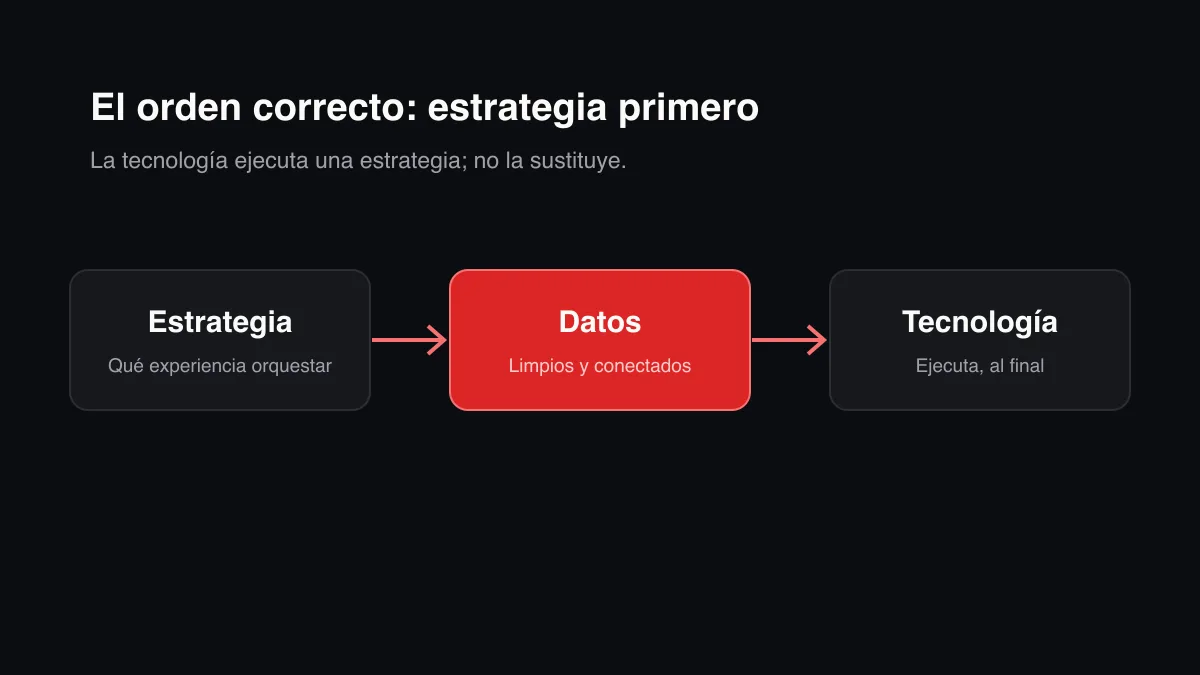
- The Correct Order: Strategy → Data → Technology
- How to Design a Customer Experience Strategy
- 1. Maturity Diagnosis
- 2. Prioritized Use Cases
- 3. Data Governance
- 4. Roadmap
- 5. Business Metrics
- The Partner's Changing Role: From Factory to Strategic Partner
- Strategy First, Always
- Related Services
- Related services
Technology Is Not the Strategy
There is a comfortable and costly belief in many organizations: that customer experience can be bought. That licensing the right platform, switching on a CDP or adding a chatbot is enough for experience to improve on its own. The tool arrives, the contract is signed, and months later the customer experience is just as fragmented as before.
The problem is almost never the software. It is that the technology was bought with no strategy behind it. A tool executes decisions; it does not make them. If no one defined what experience the company wants to deliver, to whom, with what data and under what processes, the most expensive platform in the world only automates the mess faster.
At WolfSellers we see it up close: the brands that win at customer experience are not the ones with the most tools, they are the ones with strategic clarity first. This post is about exactly that — what a customer experience strategy is, why projects fail when there isn't one, and in what order to do things so the investment pays off.
What Is a Customer Experience Strategy?
A customer experience (CX) strategy is the conscious definition of how a brand wants its customers to experience it at every touchpoint, and the plan to deliver that consistently, measurably and tied to the business. It is not an aspirational document; it is a system of decisions that answers, before any technology is touched, concrete questions:
- Who do we serve and what is that person trying to achieve at each moment of their journey?
- What experience do we want to deliver, and how does it differ from what any competitor does?
- What data do we need to personalize that experience, and what state is it in today?
- What processes and teams must connect so the experience is coherent across marketing, sales, commerce and service?
- How will we know if it works — which business metric moves?
The difference with "buying software" is fundamental, not cosmetic:
| Buying technology | Designing an experience strategy |
|---|---|
| Starts with the tool ("we need a CDP") | Starts with the customer and the business outcome |
| Measures platform adoption (active licenses) | Measures impact: conversion, retention, lifetime value |
| The experience is whatever the tool allows | The tool executes the experience you designed |
| Each team buys its own solution separately | Marketing, commerce and service run one shared plan |
| Success is "it's been implemented" | Success is "the customer notices and the business grows" |
Put simply: technology answers the "how"; strategy answers the "what" and the "why." Skipping that second part is the root cause of most disappointing CX projects.
Why Customer Experience Projects Fail
When a CX project does not deliver what was promised, the tempting diagnosis is "we picked the wrong tool." It almost never is. Projects fail for three reasons, and none of them is fixed by buying more software:
1. Lack of Strategy
Capability is bought with no destination. The organization acquires a powerful personalization platform, but no one defined what differentiated experience it wants to deliver, or to which segment. The tool ends up underused — switched on, licensed, and operating at 10% of its potential — because there is no business hypothesis to guide it.
2. Nonexistent Data Governance
Personalization is only as good as the data that feeds it. If customer data is duplicated, scattered across silos that do not talk to each other, out of date, or without clear rules about who uses it and for what, no tool will fix it. It will personalize on dirty data, which is worse than not personalizing: it speaks to the wrong customer at the wrong moment.
3. Disconnected Processes
A coherent experience requires marketing, commerce, sales and service to operate as one system. When each team has its own tool, its own version of the customer and its own goal, the customer feels the seam: they get a promotion for something they already bought, or one team has no idea what another promised. Technology does not unite processes the organization keeps apart.
The evidence that the bottleneck is not technology is overwhelming. According to data from Adobe together with Oxford Economics, 78% of organizations expect agentic AI to manage most of their interactions within the next 18 months, yet only 16% already have it implemented. More revealing still: only 51% have the adequate cloud infrastructure and 75% name data quality as their main limitation. The intent is there; what's missing is the foundation — clean data, architecture and strategy. The desire to operate with AI runs far ahead of the actual ability to do it, and that gap is not closed by one more purchase.
The Correct Order: Strategy → Data → Technology
If there is one idea worth taking away from this post, it is this sequence. The most common and most expensive mistake is to invert it — buying the technology first and hoping it defines the strategy.
- Strategy first. Define who you serve, what experience you want to deliver and what business outcome you pursue. This requires no new tool; it requires clarity and decisions.
- Data next. Once you know what experience you want to orchestrate, you know what data you need. Only then does it make sense to unify, clean and govern it — with a purpose, not "just in case."
- Technology last. The platform executes the strategy on the right data. Chosen at this point, technology amplifies a plan; chosen first, it only automates the lack of one.
Technology does not replace strategy: it executes it. It is an extremely powerful tool in the hands of those who already know what they want to achieve, and a frustrating expense in the hands of those who expect it to decide for the organization. The good news is that the Adobe Experience Cloud ecosystem is built precisely to execute ambitious experience strategies — but it is still the last step, not the first.
How to Design a Customer Experience Strategy
A CX strategy is not a one-day workshop or a slide deck. It is a process with concrete deliverables. Here is how we approach it:
1. Maturity Diagnosis
Before proposing anything, we understand where the organization stands: what data it has and in what state, what tools it already uses (and which it underuses), how processes connect — or don't — across teams, and where the real friction lives in the customer journey. Without this honest starting point, any roadmap is guesswork.
2. Prioritized Use Cases
Instead of "transforming the whole experience" — a goal that never gets off the ground — we identify concrete use cases with measurable impact and rank them by value and effort. Starting with a few cases that move a real metric builds the evidence and the organizational muscle to scale.
3. Data Governance
This is where you decide who owns each piece of data, how the customer view is unified, what quality and privacy rules apply, and how that information is activated securely. A unified, trustworthy customer view — the territory of Adobe Experience Platform — is what makes any serious personalization possible. Without governance, personalization amplifies the errors.
4. Roadmap
A realistic sequence that connects the prioritized use cases with the data capabilities and the technology required, in phases. The roadmap makes explicit what comes first, what depends on what, and what outcome is expected at each stage — so the investment is defensible and not an act of faith.
5. Business Metrics
The strategy is tied to indicators that matter to the business — conversion, retention, customer lifetime value, operational efficiency — not to vanity metrics of platform adoption. If the experience improves, the business notices; if the business does not notice, it was not a strategy.
The Partner's Changing Role: From Factory to Strategic Partner
For years, the dominant model for implementing experience technology was the factory: the brand arrived with a list of requirements, the vendor turned them into tickets and delivered exactly what was asked. If the requirements were poorly thought through, so was the result — but "the scope was met."
That model is no longer enough. A competitive customer experience is not built by executing isolated tickets; it is built by orchestrating strategy, data and technology as a system. That demands a different role: a partner who not only implements, but helps define what experience is worth orchestrating and what the organization is missing to achieve it — and who has the judgment to say when the answer is not buying more technology.
At WolfSellers we operate in that role, and we say it without arrogance: not because we have all the answers, but because we have seen enough projects to know that the right conversation starts with strategy, not with the product catalog. We combine our consulting practice — diagnosis, use cases, data governance and roadmap — with the ability to execute on Adobe Experience Cloud and to bring in AI and automation where it truly adds value. We master the technology; but we get to it after we are clear on the "what for."
If you want to go deeper into how digital experience is becoming more autonomous and orchestrated end to end, we cover it in our note on Digital Experience 2026; and if your business is commerce, the same principle — data and architecture before tools — applies to agentic commerce.
Strategy First, Always
The question worth asking is not "which tool do we buy?" but "what experience do we want to deliver and what are we missing to achieve it?" Buying technology without that clarity is the most expensive way to stay exactly where you are. Designing the strategy first — and letting technology execute it — is what separates brands that invest in CX from those that merely spend on software.
That is the conversation worth having before signing any license. Let's talk.
Related Services
If this topic is relevant to your business, these WolfSellers services can help you implement it:
Related services
If this topic is relevant to your business, these services from WolfSellers can help you implement it: